
 March 18, 2026, 2:35 p.m.
What is Penetration Testing?
Penetration testing (or pentest for short) is the process of testing an organization's information systems, network infrastructure, or applications in an authorized manner from a real attacker's perspective. The goal is to identify security vulnerabilities, determine risk levels, and take corrective action before a real cyberattack occurs.
Penetration testing is not done to damage your system, but on the contrary, to protect it. Cybersecurity experts, also known as ethical hackers, test your system using the techniques and tools used by attackers; however, they do this within a legal framework and with your permission.
The Difference Between Penetration Testing and Vulnerability Scanning
These two concepts are often confused, but there are important differences between them:
- Vulnerability Scanning: Detects known security vulnerabilities in the system with automated tools. No in-depth analysis is performed; only potential risks are listed.
- Penetration Testing: Performed by an expert team using manual and automated methods. It proves whether vulnerabilities can actually be exploited and evaluates business impact.
Simply put: Vulnerability scanning checks whether doors are locked; penetration testing actually tries to get inside.
Types of Penetration Testing
Penetration tests are divided into three main categories according to the level of information provided to the testing team:
- Black Box: The testing team is given no information about the target system. It is the method that best simulates real-world attacks.
- White Box: The testing team is provided with complete information about the system (source code, network diagrams, etc.). It offers the most comprehensive and in-depth analysis.
- Grey Box: Partial information is provided. For example, a user account is given to test how the system can be exploited from the inside. It is the most commonly used method.
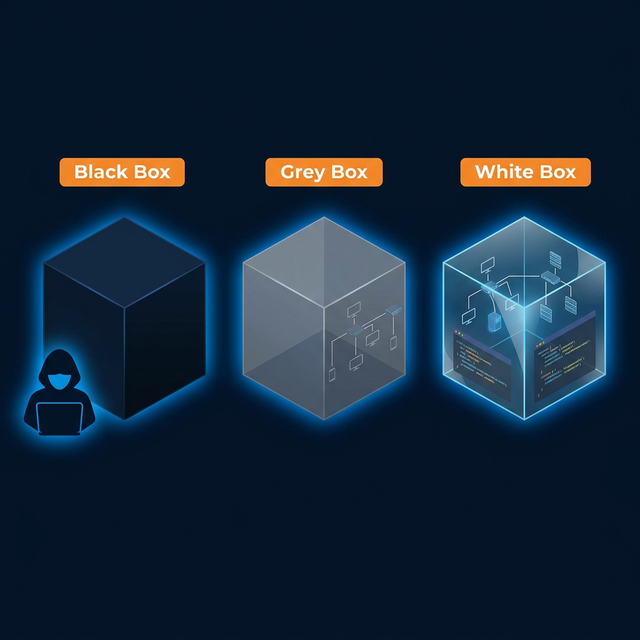
Black Box, Grey Box and White Box — three different penetration testing approaches
Penetration Testing Scopes
- Network Penetration Testing: Security of internal and external network infrastructure
- Web Application Penetration Testing (WAPT): Website and API security (OWASP Top 10 focused)
- Mobile Application Penetration Testing: iOS and Android application security
- Social Engineering Testing: Phishing and manipulation attacks targeting employees
- Physical Security Testing: Assessment of building and facility security
- OT/SCADA Penetration Testing: Industrial control systems security
How Is Penetration Testing Done? Step-by-Step Process
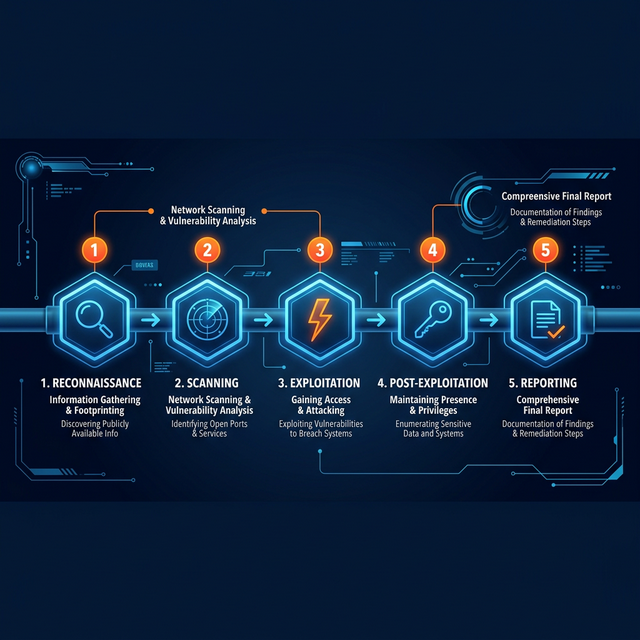
A professional penetration test consists of specific stages in accordance with international methodologies (PTES, OWASP, OSSTMM):
Stage 1: Scoping and Planning
Clarifying the scope before the test begins is of critical importance. At this stage, the following are determined:
- Systems to be tested, IP ranges and applications
- Test type (Black Box / White Box / Grey Box)
- Timeline and test window
- Legal permissions and communication channels (signed authorization document)
- Out-of-scope systems
This stage legally secures both the client and the testing team.
Stage 2: Reconnaissance
The testing team collects as much information as possible about the target system. It is conducted in two subcategories:
- Passive Reconnaissance: Information is collected using OSINT (open source intelligence) techniques without direct contact with the target system. DNS records, WHOIS queries, social media, Shodan, Google Dork techniques are used.
- Active Reconnaissance: Information is collected by directly interacting with the target system. Port scanning, service detection, banner grabbing are performed.
Stage 3: Vulnerability Analysis
Security vulnerabilities in the system are identified using the information collected in the reconnaissance stage:
- Automated vulnerability scanning tools (Nessus, OpenVAS, Burp Suite)
- Manual analysis and source code review
- Comparison with CVE (Common Vulnerabilities and Exposures) databases
- Misconfiguration and weak password checks
Stage 4: Exploitation
At this stage, it is proven whether the identified vulnerabilities can actually be exploited. The goal is not to damage the system, but to document that access is possible:
- Use of vulnerability exploits in a controlled environment
- Authentication bypass attempts
- Validation of attack vectors such as SQL Injection, XSS, RCE
- Unauthorized data access testing

In the exploitation stage, vulnerabilities are proven in a controlled environment
Stage 5: Post-Exploitation
After gaining access to the system, what a real attacker could do is simulated:
- Lateral Movement: Spreading from the compromised system to other systems
- Privilege Escalation: Obtaining administrator privileges from a low-privileged account
- Data Exfiltration Simulation: Demonstrating accessibility to critical data
- Persistence: Testing persistent access mechanisms to the system
Stage 6: Reporting
The report, which is the most critical output of penetration testing, consists of two main sections:
- Executive Summary: Findings for non-technical readers, overall risk level, and strategic recommendations
- Technical Detail Report: Technical description of each vulnerability, CVSS risk score, step-by-step proof of concept (PoC), and recommended solutions
A quality penetration testing report does not just list problems; it provides prioritized, actionable solution recommendations for each finding.
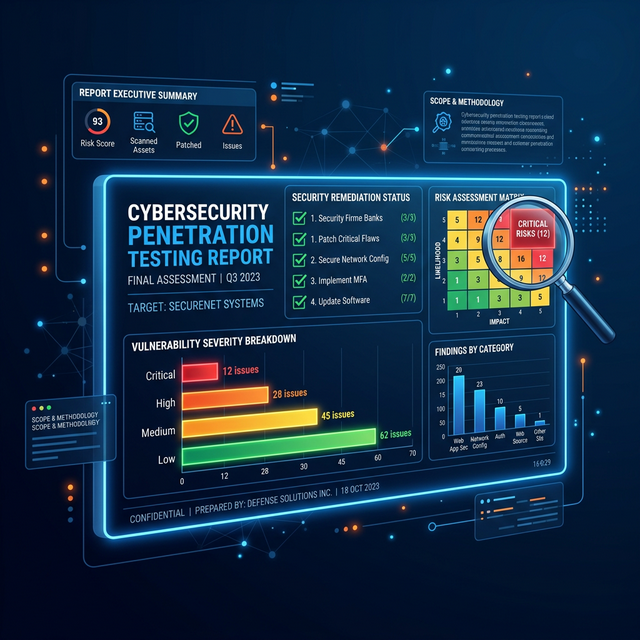
Professional penetration testing report: findings in critical, high, medium, and low risk categories
Stage 7: Retest
After the identified vulnerabilities are remediated, retesting is performed to verify that the fixes are actually effective. Although this stage is often overlooked, it is an integral part of a comprehensive security process.
Who Should Get Penetration Testing?
In Turkey, it is mandatory or strongly recommended to conduct penetration testing in the following situations:
- Legal Obligation: Finance, energy, and telecom companies subject to BDDK, EPDK, SPK, BTK regulations
- Certification Requirement: ISO 27001, PCI DSS, or SOC 2 compliance processes
- Proactive Security: All companies that hold customer data, operate e-commerce or SaaS platforms
- Defense Industry:


Similar Posts