
 March 30, 2026, 10:28 a.m.
Strengthen Email Security with SPF, DKIM and DMARC: The Most Effective Defense Against Social Engineering Attacks
Today, the vast majority of cyberattacks are carried out through social engineering techniques that target the human factor rather than sophisticated technical vulnerabilities. Leading these attacks are identity fraud and email-based threats. SPF, DKIM and DMARC protocols create a critical line of defense against social engineering attacks by strengthening organizations' email security.
Email, besides being the backbone of corporate communication, is one of the most exploited attack vectors by cybercriminals. Attacks such as phishing, CEO fraud, ransomware distribution and Business Email Compromise (BEC) are typically carried out through fake emails. At this point, email authentication protocols such as SPF, DKIM and DMARC come into play, enabling sender identity verification and detection of fake emails.
What is SPF (Sender Policy Framework)?

Email server protection with SPF protocol
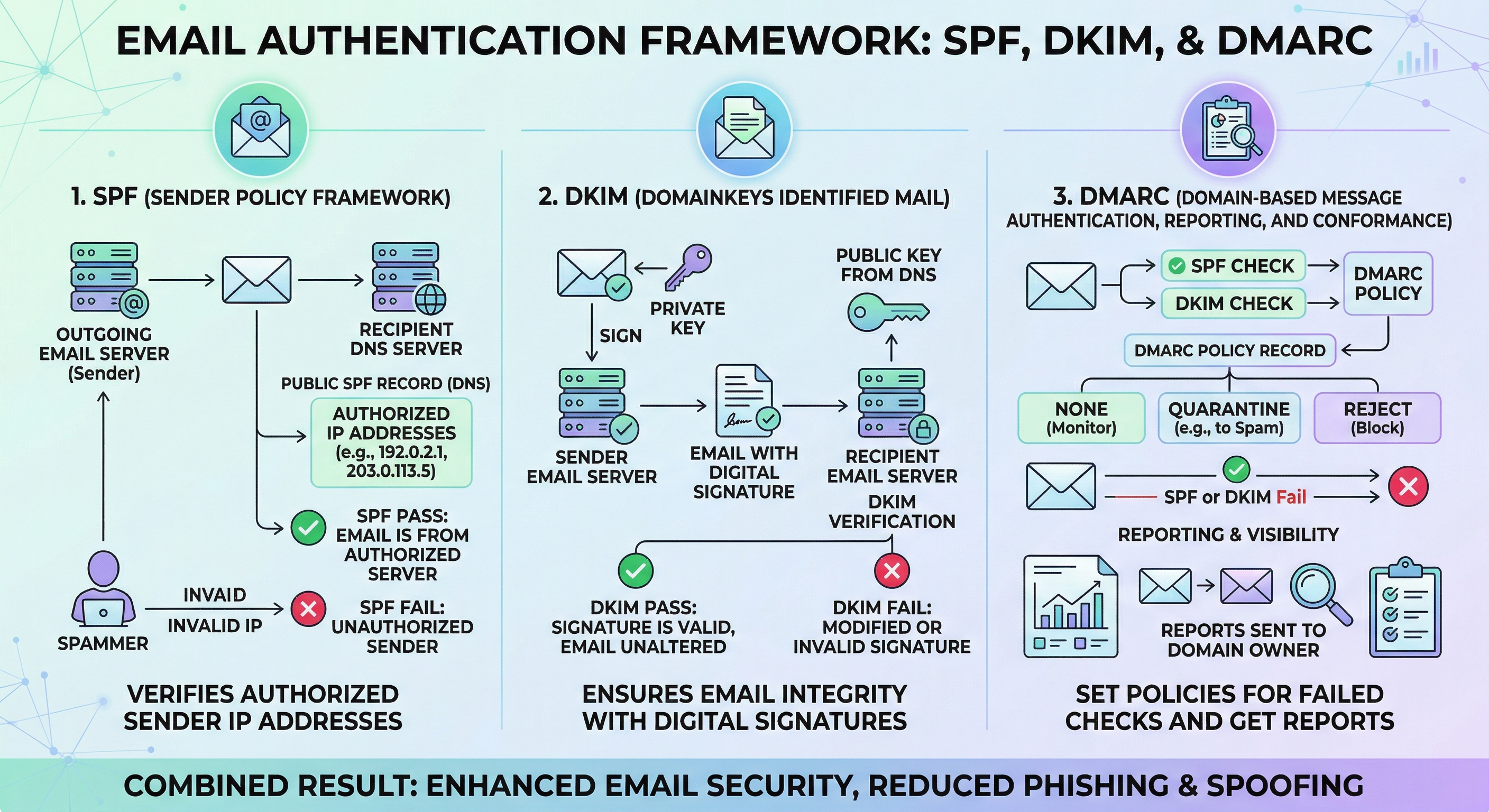
SPF (Sender Policy Framework) is an email validation system that allows domain owners to specify which email servers are authorized to send emails on behalf of their domain names. This protocol publishes a list of authorized IP addresses through DNS (Domain Name System) records.
SPF's working principle is quite simple: When an email is received, the receiving server checks the DNS records of the sender's domain address and verifies whether the IP address of the server sending the email is in the list of authorized servers in the SPF record. If the sending server is not on the authorized list, the email can be marked as suspicious or rejected.
How to Configure an SPF Record?
An SPF record is added as a DNS TXT record for the domain and includes these basic components:
- v=spf1: Specifies the SPF record version
- ip4/ip6: Defines authorized IPv4 or IPv6 addresses
- include: Includes SPF records of third-party email services
- all mechanism: Sets policy for unlisted servers (-all: reject, ~all: soft fail, +all: accept)
An example SPF record may look like this:
v=spf1 ip4:192.0.2.0/24 include:_spf.google.com -all
What is DKIM (DomainKeys Identified Mail)?
DKIM (DomainKeys Identified Mail) is an authentication method that enables emails to be digitally signed during sending and this signature to be verified by the recipient. Unlike SPF, DKIM also checks whether the email content has been altered, thus guaranteeing the integrity of the email.
DKIM works using asymmetric encryption. The sending server signs the email with a private key and this signature is added to the email header. The receiving server then retrieves the public key from the sender's DNS records to verify the signature. If the signature is verified, it confirms that the email actually came from the specified domain and was not altered in transit.
Security Advantages Provided by DKIM
- Authentication: Proves the email was sent by the genuine sender
- Integrity Check: Guarantees the email content was not altered during transit
- Non-repudiation: Prevents the sender from denying they sent the email
- Spam Filtering: DKIM-signed emails pass through spam filters more easily
What is DMARC (Domain-based Message Authentication, Reporting and Conformance)?

DMARC reporting and policy management panel
DMARC (Domain-based Message Authentication, Reporting and Conformance) is a top-level authentication and policy framework that brings together SPF and DKIM protocols to offer a comprehensive approach to email security. DMARC allows domain owners to specify what should be done when SPF and DKIM checks fail and to receive detailed reports about email traffic.
One of DMARC's most important features is providing domain owners with complete control over how their emails are processed. There are three basic policy levels:
- none (monitoring mode): Only reporting is done, emails are not interfered with
- quarantine: Emails that fail validation are directed to the spam folder
- reject: Emails that fail validation are completely rejected
DMARC Reporting and Monitoring
One of DMARC's most valuable features is providing domain owners with detailed reports about email traffic. There are two types of DMARC reports:
- Aggregate Reports (RUA): Contains general statistics of email traffic, showing which sources emails are sent from and authentication results
- Forensic Reports (RUF): Contains detailed analysis of emails that failed validation and helps investigate security incidents
Through these reports, organizations can detect unauthorized email sending attempts using their own domains and take proactive measures against identity spoofing attacks.
How Do SPF, DKIM and DMARC Reduce Social Engineering Attacks?
Social engineering attacks attempt to achieve their goals by manipulating human psychology rather than bypassing technical security measures. Most of these attacks are carried out through fake emails that appear to come from sources considered trustworthy by the victim. SPF, DKIM and DMARC protocols protect organizations by preventing such attacks in the following ways:
1. Prevention of Domain Spoofing Attacks
Cybercriminals frequently send phishing emails by impersonating legitimate company domains. The combination of SPF, DKIM and DMARC significantly reduces such domain spoofing attacks by allowing only authorized servers to send emails from a specific domain name. Employees and customers can be assured that emails coming from the organization's genuine domain are verified.
2. Protection Against CEO Fraud and BEC Attacks
In Business Email Compromise (BEC) attacks, attackers impersonate senior executives to request urgent money transfers or sensitive information from employees. DMARC policies prevent unauthorized use of the organization's domain and ensure such fraudulent emails are blocked before reaching employees.

Similar Posts