
 Aug. 1, 2026, 10:32 p.m.
Enterprise Wi-Fi Security: Defense Guide Against WPA3, 802.1X and Wireless Network Attacks
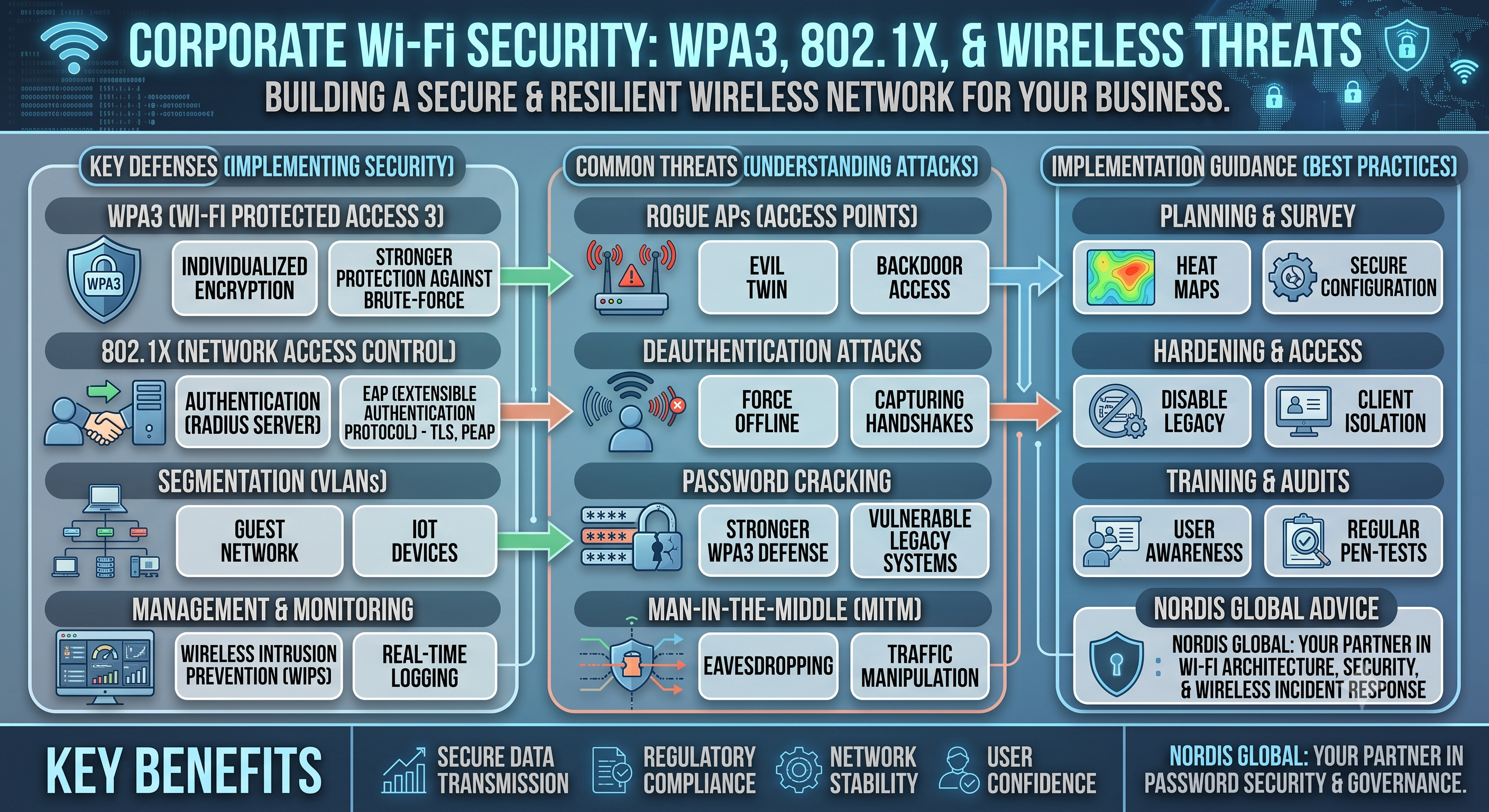
In today's digital business environment, wireless networks have become an indispensable part of corporate operations. However, this convenience brings serious security risks along with it. Enterprise Wi-Fi security should not be limited to password protection alone; it requires a comprehensive security strategy. In this threat spectrum ranging from the WPA3 encryption standard to the 802.1X authentication protocol, from Rogue AP attacks to Evil Twin traps, it is vitally important for organizations to adopt a proactive approach.
Modern businesses use wireless connectivity across a wide spectrum, from employee mobile devices to IoT sensors on production floors. This situation means numerous entry points for attackers. The vulnerabilities we frequently encounter in enterprise wireless networks during security assessments conducted as Nordis Global demonstrate that organizations are not sufficiently aware of this issue.
Wireless Network Attacks: Current Threat Landscape

Rogue Access Point Attacks
Rogue AP attacks are one of the most insidious threats to enterprise wireless network security. When an attacker or unaware employee connects an unauthorized access point to the corporate network, all network security policies are bypassed. These rogue access points bypass firewalls, intrusion detection systems, and other defense mechanisms, providing attackers with direct access to the internal network.
Rogue APs can emerge in two ways: They can be deliberately placed by attackers or can result from well-intentioned but uninformed actions of employees. The second scenario is particularly dangerous because most organizations do not have adequate control mechanisms for such insider threats. Regular wireless network scans and Wireless Intrusion Prevention System (WIPS) solutions provide effective defense against these threats.
Evil Twin Attacks
Evil Twin attacks are a sophisticated attack type that combines social engineering with technical expertise. The attacker creates a fake access point that mimics the SSID (network name) of the legitimate corporate Wi-Fi network. Users connect to this fake network thinking they are connecting to a trusted network, and all traffic passes through the system controlled by the attacker.
The impact of Evil Twin attacks can be extremely devastating. From the man-in-the-middle position, the attacker can capture users' login credentials, corporate data, and even encrypted traffic. Detection of these attacks can be difficult because users experience a normal network experience and do not suspect anything. WPA3-Enterprise and mutual authentication mechanisms offer the most effective defense against such attacks.
PMKID Attacks: The Achilles' Heel of WPA2
PMKID (Pairwise Master Key Identifier) attacks are a new generation attack method discovered in 2018 that exploits a structural vulnerability in the WPA2 protocol. While traditional WPA2 cracking attacks require capturing a four-way handshake, PMKID attacks enable offline password cracking by capturing a single authentication frame.
The danger of this attack method is that there is no need to wait for any client to connect to the network. The attacker can obtain this information by passively capturing a single EAPOL frame and then perform a powerful hash cracking attack. Networks using weak passwords are particularly vulnerable to this attack. Transitioning to WPA3 and using strong, complex passwords are the most basic protection methods against this vulnerability.
WPA3: Next-Generation Wireless Security Standard

Wi-Fi Protected Access 3 (WPA3) is an advanced security standard announced by the Wi-Fi Alliance in 2018, designed to replace WPA2. WPA3 offers stronger encryption, enhanced authentication, and better protection against modern threats, especially in enterprise environments.
WPA3-Personal and WPA3-Enterprise Differences
WPA3-Personal is designed for individual users and small businesses, providing more secure password-based authentication using the Simultaneous Authentication of Equals (SAE) protocol. SAE addresses the vulnerabilities of the traditional Pre-Shared Key (PSK) method by offering protection against offline dictionary attacks and providing perfect forward secrecy.
WPA3-Enterprise is developed for medium and large-scale organizations, offering military-grade security with 192-bit encryption support. This mode works integrated with 802.1X authentication infrastructure, enabling user-based access control and implementation of advanced security policies. The use of WPA3-Enterprise is critically important especially in the healthcare, finance, and public sectors where sensitive data is processed.
WPA3-Enterprise Setup and Configuration
Implementing WPA3-Enterprise in an enterprise environment requires careful planning and proper configuration. The first step is to evaluate the WPA3 compatibility of the existing wireless infrastructure. Older access points and network controllers may not support WPA3 and may require hardware upgrades.
During the configuration process, establishing the 802.1X infrastructure is a fundamental requirement. This includes configuring a RADIUS (Remote Authentication Dial-In User Service) server, establishing a digital certificate infrastructure, and centralized management of user credentials. Active Directory or LDAP integration facilitates user management and ensures consistency with enterprise identity management systems.
When defining security policies, separate SSIDs and VLANs should be created for different user groups. For example, while administrators have full network access, guest users should be limited to internet access only. This segmentation approach limits the impact of potential security breaches.
802.1X Authentication: The Foundation of Enterprise Wireless Security
IEEE 802.1X is a port-based authentication standard developed for network access control. Wired


Similar Posts