

 May 19, 2026, 12:19 a.m.
Cybersecurity Awareness Training: Protect Your Digital Identity with Strong Password Creation and Password Managers
Passwords, the key to our identity in the digital world, are among the most critical security elements today. However, statistics reveal a quite striking reality: 81% of users continue to use weak passwords that are compromised in data breaches or easily guessable. The fact that passwords like "123456", "password", or "12345678" still top the list of most commonly used passwords demonstrates how critical cybersecurity awareness is.
Every individual working in corporate environments is actually the most important link in the organization's security chain. A weak password can compromise not only personal accounts but the entire corporate network. Therefore, strong password creation and modern password management techniques are fundamental cybersecurity skills that every employee must know.
The Threat Landscape Created by Weak Passwords
Research conducted by cybersecurity experts shows that the cost of weak passwords to organizations increases every year. According to Verizon's 2023 Data Breach Investigations Report, 81% of data breaches involve weak, default, or stolen credentials. These figures clearly demonstrate how critical password security is.
Common Password Mistakes
- Short and simple passwords: Passwords 6-8 characters long can be cracked in seconds with modern hardware
- Using personal information: Easily guessable information like birth dates, names, surnames
- Dictionary words: Passwords consisting of a single word are vulnerable to dictionary attacks
- Common passwords: Widely used combinations like "Admin123", "Password123"
- Using the same password across multiple accounts: When one account is compromised, all accounts are at risk
Credential Stuffing: The Great Threat of Modern Times
Credential stuffing is a type of attack where cybercriminals use automated tools to try username and password pairs obtained in a data breach across thousands of different services. The main reason this attack method is so effective is users' habit of using the same password across different platforms.
For example, if a user's social media account is compromised in a data breach and they use the same password for their corporate email account, attackers can use this information to gain access to the corporate network. According to Akamai's reports, billions of credential stuffing attempts occur daily, and a significant portion of them are successful.
Strong Password Creation: Principles and Best Practices
Creating a strong password may seem complicated, but with the right methods, it's possible to create passwords that are both secure and memorable. Modern cybersecurity standards recommend the following criteria for password creation:
Basic Password Criteria
- Length: Minimum 12, ideally 16 characters or longer
- Complexity: Combination of uppercase, lowercase, numbers, and special characters
- Uniqueness: Different and unique password for each account
- Unpredictability: Away from personal information, common words, and patterns
- Periodic changes: Regular updates especially for critical accounts
Passphrase Concept: The Balance of Security and Usability
Passphrase is an approach that stands out in modern password security. Unlike traditional complex passwords, passphrases consist of long but memorable sentences and are actually mathematically much more secure than short complex passwords.
Example passphrase: An expression like "BlueSky!2024Spring&Coffee" creates an excellent password in terms of both length and complexity. In this approach:
- Meaningful but unpredictable words are combined
- Special characters or numbers are added between words
- Upper-lowercase variations are used
- Total length reaches 20+ characters
The National Institute of Standards and Technology (NIST) considers length more important than complexity in its current guidelines and encourages the use of passphrases. While cracking a 12-character complex password takes days, cracking a 20+ character passphrase can take years or even centuries.
Password Managers: The Foundation of Modern Password Security
Creating different, strong, and long passwords for each account is a perfect strategy in theory, but in practice, it's impossible to remember dozens or even hundreds of passwords. This is exactly where password managers come into play and become indispensable tools of modern password security.
What is a Password Manager and How Does it Work?
Password managers are applications that store all your passwords in an encrypted vault and are protected with a single master password. With these tools:
- You only need to remember one strong master password
- You can automatically create strong, unique passwords for each account
- Passwords are protected with military-grade encryption
- You save time with automatic form filling
- You get access across all your devices with cross-platform synchronization
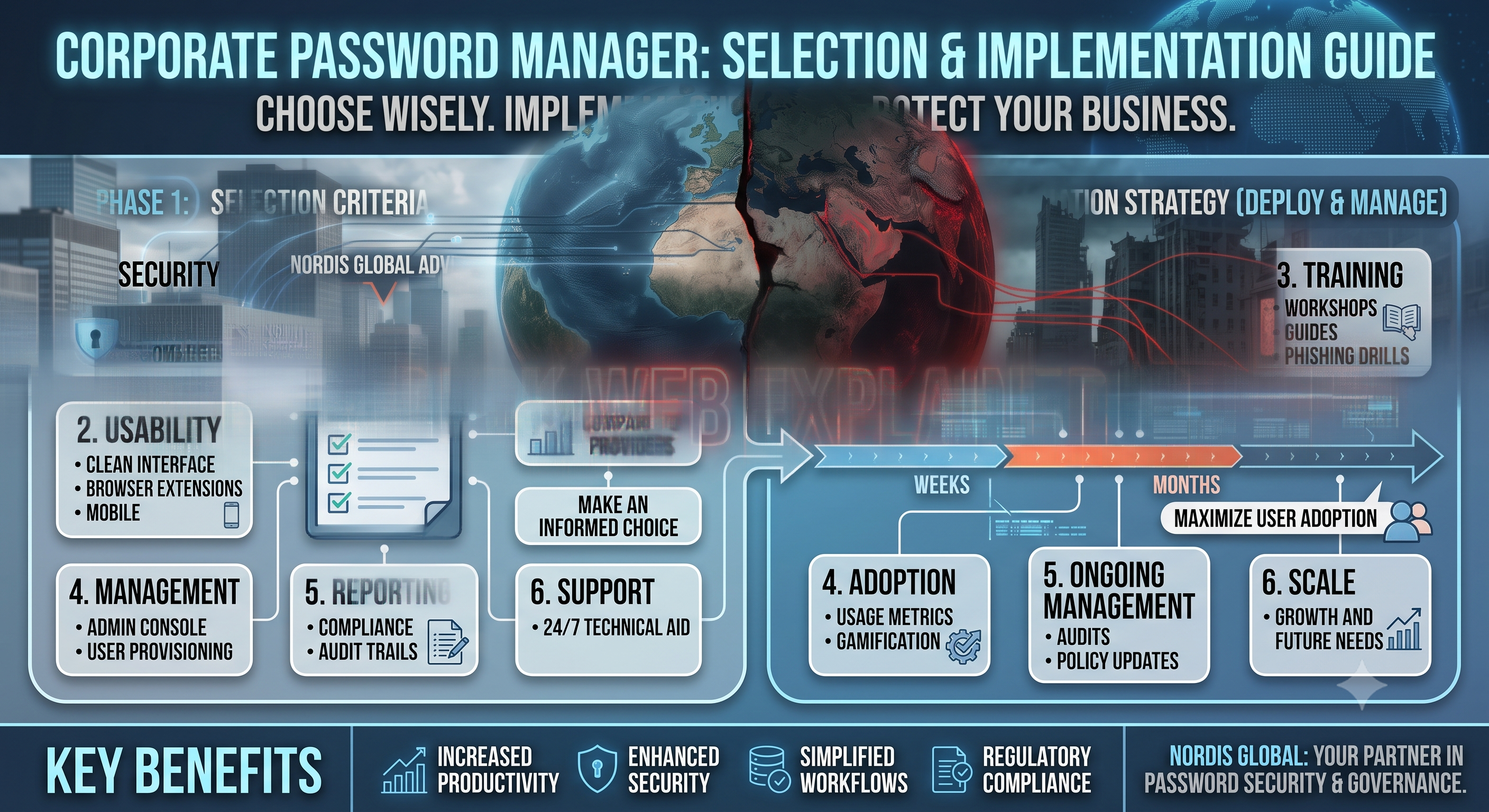
Using Password Managers in Corporate Environments
Beyond individual use, enterprise password managers offer significant advantages to organizations:
- Central management: IT teams can centrally enforce password policies
- Shared access: Team accounts can be securely shared
- Audit logs: Access and usage can be tracked
Similar Posts